538 Directors comprise the Top 1000 International Box Office, with 254 representing at least two films. Why is it that the highest rated directors are actually the worst performing at the box office? We review IMDB Ratings and the Top 1000 movies at the Box Office to try and find correlations. You’ll see “tickets” referred to here, which was our way to adjust for inflation.
What’s the general correlation of IMDB ratings to box office results?
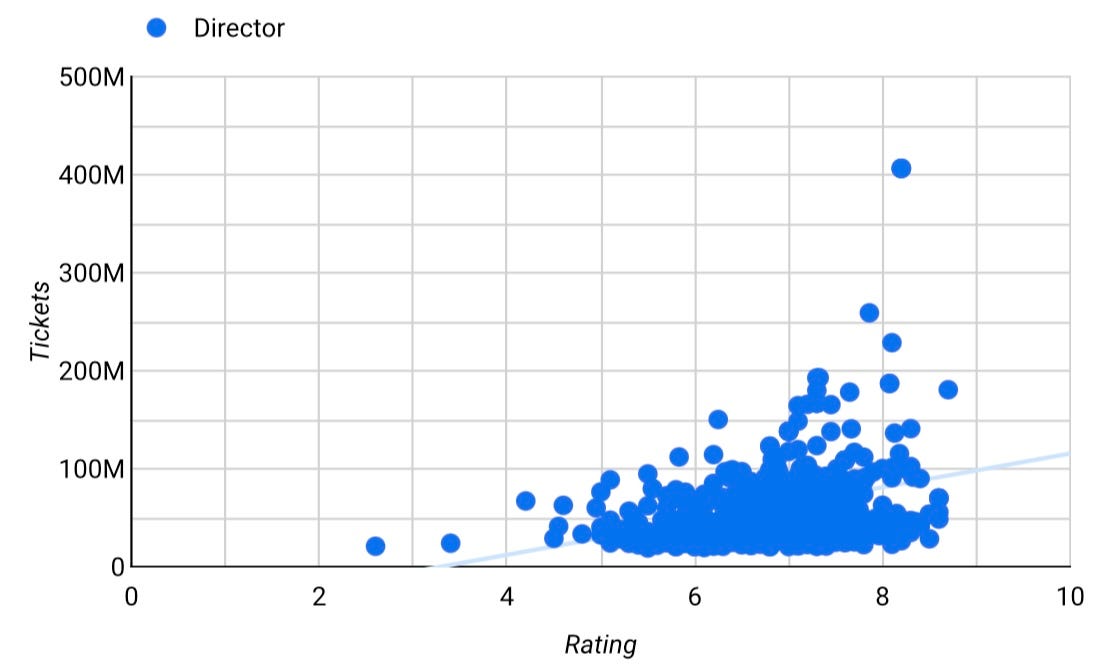
Generally, there’s a strong positive correlation that when a director performs well at the box office, it’s generally because they made a great movie (with one notable 2.6 star exception).
The spread is large because of many different preferences, but the trend is strong.
Does that change with one-hit wonders?
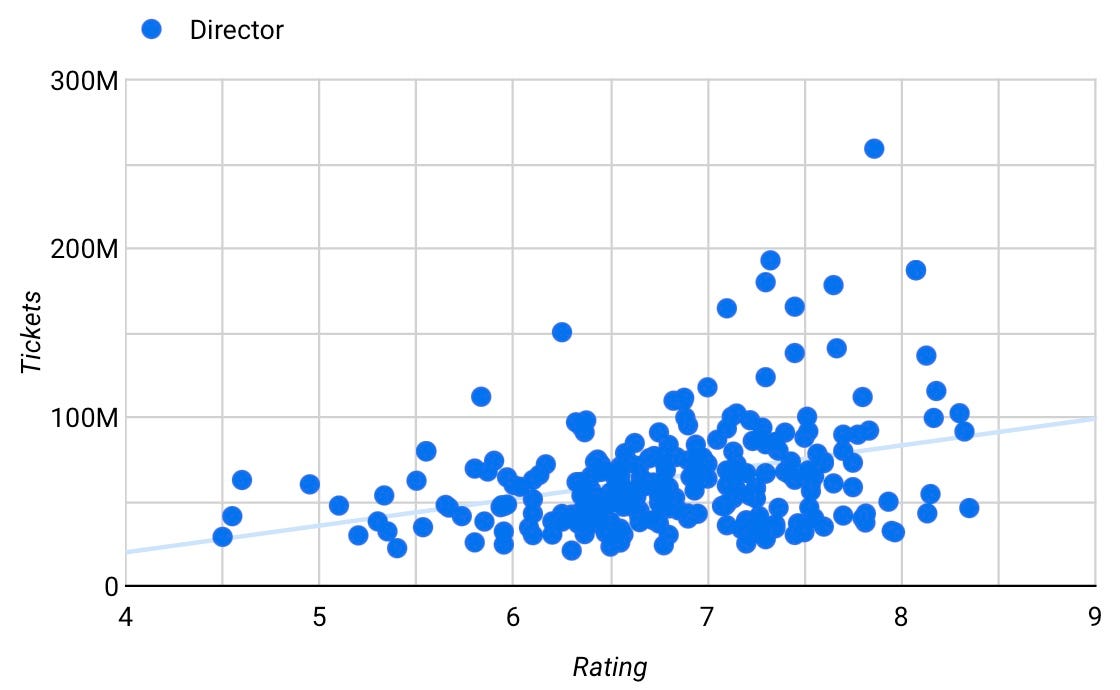
Even when you filter out the one-hit wonders (directors with one film like Gone with the Wind Director Victor Fleming), there is still a strong correlation.
The lesson here is clear: If you want to perform well at the box office, make a great movie.
Who are the best directors?
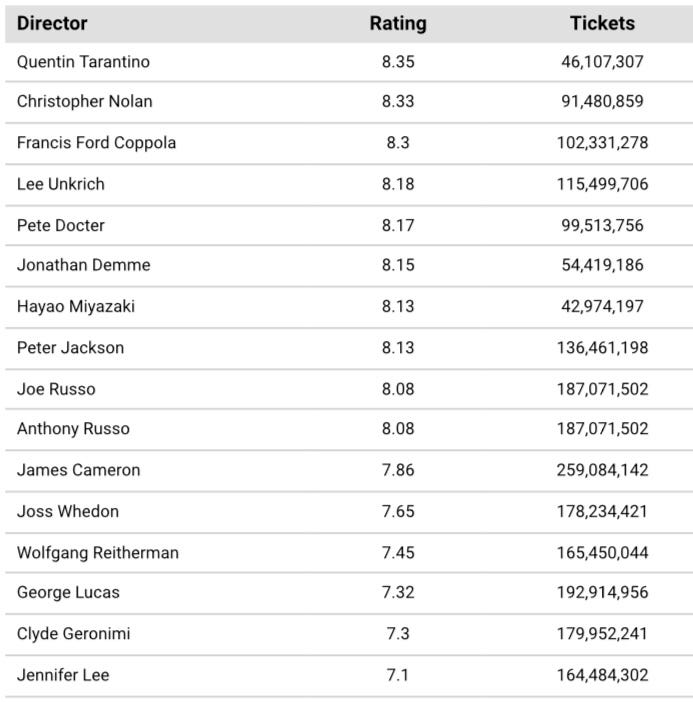
16 different directors have averaged either 150m tickets or an 8.0 rating. These are truly the cream of the crop.
But wait. Our previous assumption might be wrong. 5 of the top 7 directors averaged less than 100m tickets, whereas all of the remaining top directors averaged more than 100m.
This begs the next question. Is the correlation for the best directors different than the correlation for all directors?
P.S. My favorite movie is The Big Short, directed by Adam McKay, who is not in the Top 1000.
Is the best director trend different than all directors?
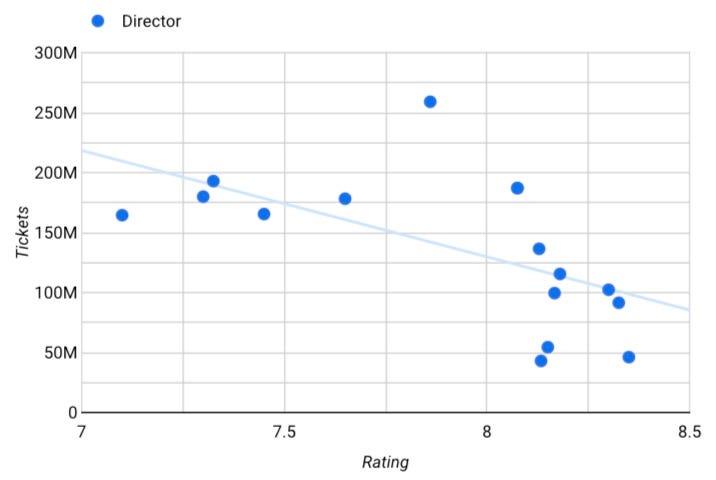
The answer is emphatically yes. The trend is so apparent that if you look at the trendline of the highest rated directors (8 stars or 150m average tickets), the correlation of “higher ratings equals more money” is literally the exact opposite.
This same trend happens for 7 stars or 100m average, though not as drastic. The more directors you include, the more the trend reverses back to the original conclusion.
Conclusions and Possibilities
This trend is so fascinating that it begs the question: why? Here are my theories:
1. We’re already looking at the best by narrowing to the Top 1000. The further you go up on the success ladder, the more a director has to choose: Do I appeal to a broad audience (box office), or do I make the absolute best film ever? The three directors closest to the line are George Lucas (Star Wars), Francis Ford Coppola (Godfather), and Lee Unkrich (various Pixar). Star Wars, despite being great films, were about appealing to a mass audience, even if it meant sacrificing some cinematic perfection. Coppola and Unkrich on the opposite side, don’t have as much mass audience appeal due to an R Rating and G Ratings, but are closer to perfection.
2. Higher Volume introduces worse films. It’s hard to be perfect. The more films a director makes, the higher the standard deviation gets for ratings AND tickets. That’s partially due to the quality of the film, but also speaks to audience expectations. Audiences are expecting one thing because it’s the same director, but it’s not AS good as their other films (think Lord of the Rings and The Hobbit. Sorry Peter Jackson).
Business Lessons Learned
Specialize
If you try to please everyone, you’ll end up making a poorer product
Fame and popularity do not automatically equal success. How many of those Top 16 did you recognize? I would bet very few.
Choose the metrics that you want to focus on.
ANAF is a fun insightful series brought to you by WIPP Data, a Data Agency bringing you custom data solutions for any business.
Learn More
Email Us
Book an Appointment
Data Source: BoxOfficeMojo and IMDB. This is top 1000 international box office results, pre-inflation adjusted. Then, adjusted for inflation by converting to tickets.
 WIPP Data Blog
Leave a comment